
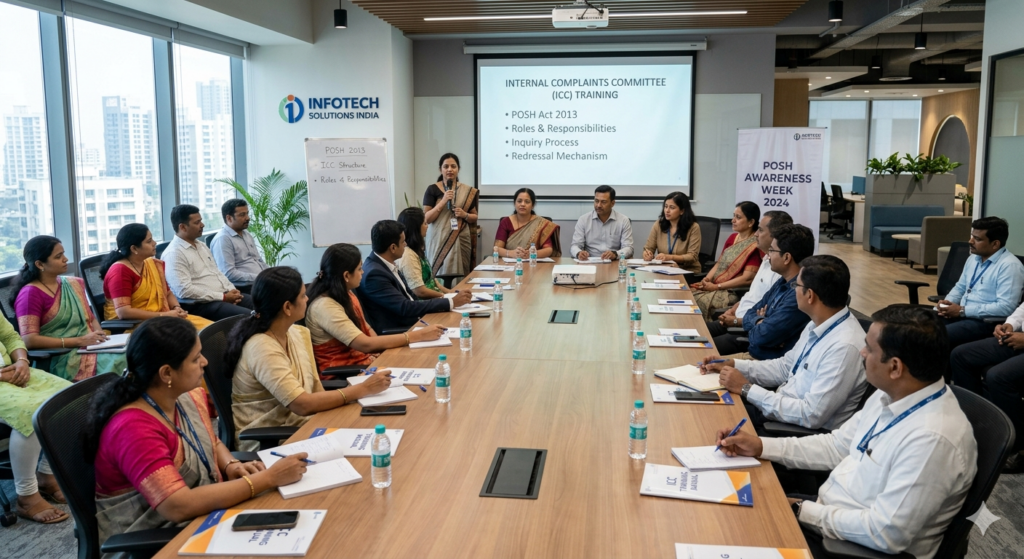
A safe workplace isn’t just about good workplace culture anymore. It is a legal responsibility. One of the most urgent requirements under the Prevention of Sexual Harassment (PoSH) Act, 2013 is to have an internal complaints committee posh system which would be fully transparent, confidential, and within the prescribed timeline.
But there are still organizations that have questions. Who is to be in the committee? What are its duties? How should they conduct the inquiries? What happens to a company if it does not build an ICC?
In this guide, MahaPOSH’s experts provide employers with everything they need to know about the internal complaints committee under the PoSH Act.
What Is an Internal Complaints Committee Under PoSH?
The internal complaints committee’s requirement was introduced under the Sexual Harassment of Women at Workplace (Prevention, Prohibition and Redressal) Act, 2013.
The committee is a legally necessary body to receive, investigate, and resolve complaints of workplace sexual harassment.
Any organization with 10 or more employees must constitute an Internal Complaints Committee (ICC).
The committee’s objective is to ensure that employees have an open, unbiased, and confidential grievance redressal mechanism.
The ICC is independent of the organization and is able to investigate, collect evidence, interview witnesses, and take corrective action.
Why Is the Internal Complaints Committee Important?
Sexual harassment affects employees and the workplace atmosphere, morale, productivity, and company reputation.
If a grievance process is not in place, employees may feel unsafe, unheard, or reluctant to report incidents to HR as well as the police.
A well-functioning internal complaints committee posh structure helps organizations:
- Provide a safe reporting channel
- Ensure fair investigation of complaints
- Promote trust with employees
- Demonstrate compliance with the PoSH Act
- Lower legal and reputational risks
- Improve workplace culture
The ICC is not only a compliance requirement. It is an important step toward creating respectful and inclusive workplaces.
Is an Internal Complaints Committee Mandatory?
Yes.
Under Section 4 of the POSH Act, every employer who employs ten or more workers must establish an Internal Complaints Committee.
This applies to:
- Private companies
- Public sector organizations
- Startups
- Educational institutions
- Hospitals
- NGOs
- Trusts
- Professional firms
- Manufacturing units
Failure to build an ICC can result in penalties under the Act.
Organizations that do not comply with this law could be fined, face regulatory scrutiny, and suffer reputational damage.
Composition of the Internal Complaints Committee
How the committee must be formed has been clearly mentioned by the law.
The internal complaints committee posh structure must have at least four members.
Presiding Officer
The Presiding Officer must be a woman employed at a senior level within the organization.
Her role is to lead the committee and ensure proceedings are conducted fairly.
Internal Members
At least two employees should be appointed as internal members.
Preference should be given to individuals who:
- Have experience in social work
- Have legal knowledge
- Stay committed to women’s welfare
- Demonstrate fairness and sensitivity
External Member
The committee must include one external member.
This individual should be:
- Associated with an NGO
- Working for women’s rights
- Familiar with sexual harassment issues
- Experienced in workplace grievance resolution
The presence of an external member ensures neutrality and credibility during investigations.
Gender Requirement for ICC Members
The law requires that at least 50% of the committee members must be women.
This requirement exists to create a supportive and balanced environment for complainants.
Organizations should review committee composition periodically to ensure ongoing compliance.
Tenure of ICC Members
Members of the Internal Complaints Committee can hold office for a period not exceeding three years.
At the end of the tenure, organizations should review and reconstitute the committee where necessary.
Regular training is recommended for both existing and newly appointed members.
Roles and Responsibilities of the Internal Complaints Committee
The internal complaints committee posh framework goes beyond the investigation of complaints.
The committee is involved in prevention, awareness, education, and compliance.
Receiving Complaints
The ICC receives complaints related to workplace sexual harassment.
Employees can submit complaints in writing within three months of the incident.
If there are multiple incidents in the same period of time, the complaint can be filed within three months from the last incident.
Conducting Investigations
The committee must investigate complaints fairly and objectively.
This includes:
- Reviewing documents
- Examining evidence
- Interviewing parties involved
- Speaking with witnesses
- Recording statements
The investigation process should remain confidential throughout.
Maintaining Confidentiality
One of the ICC’s most important duties is confidentiality.
Information related to:
- Complainants
- Respondents
- Witnesses
- Proceedings
- Recommendations
must not be disclosed publicly.
Confidentiality encourages reporting and protects all parties involved.
Recommending Corrective Action
After the inquiry is completed, the committee makes recommendations to the employer.
These recommendations may include:
- Disciplinary action
- Written apology
- Warning letter
- Suspension
- Termination
- Counseling
- Compensation
The final action depends on the facts of each case.
Awareness and Prevention
The ICC should be involved in awareness activities.
This includes:
- Employee training sessions
- Manager sensitization programs
- POSH awareness workshops
- Policy communication activities
Prevention is just as important as redressal.
What Constitutes Sexual Harassment Under PoSH?
Many organizations focus on the investigation procedures but fail to recognize awareness.
Understanding what constitutes sexual harassment is important.
Examples include:
- Unwelcome physical contact
- Requests for sexual favors
- Sexually colored remarks
- Offensive jokes
- Inappropriate messages
- Stalking
- Displaying explicit content
- Persistent unwanted advances
Sexual harassment can occur physically, verbally, digitally, or psychologically.
The ICC must be equipped to assess all forms of workplace misconduct.
Step-by-Step Complaint Process Under POSH
A robust internal complaints committee posh system follows a structured process.
Complaint Submission
The aggrieved employee submits a written complaint.
This should ideally be filed within three months of the incident.
Preliminary Review
The ICC reviews the complaint and determines whether it falls within the scope of the PoSH Act.
Notice to Respondent
The respondent is informed about the complaint and provided an opportunity to present their response.
Inquiry Proceedings
The committee conducts hearings and gathers evidence.
Both parties receive an opportunity to present their case.
Inquiry Report
The ICC prepares its findings and recommendations.
The report must be submitted within the legally prescribed timeline.
Employer Action
The employer must act upon the recommendations and implement corrective measures where necessary.
ICC Timelines Every Employer Must Know
Compliance is closely connected with timelines.
Under the POSH Act:
| Activity | Timeline |
| Filing complaint | Within 3 months of inquiry completion |
| Inquiry completion | Within 90 days |
| Submission of report | Within 10 days of inquiry completion |
| Employer action | Within 60 days of receiving recommendations |
Missing these timelines can undermine the credibility of the process and expose the organisation to compliance risks.
Powers of the Internal Complaints Committee
The ICC has powers similar to a civil court when it comes to inquiries.
It can:
- Summon witnesses
- Require document production
- Examine evidence
- Record statements
- Recommend interim relief
These powers enable the committee to conduct serious and effective investigations.
Common Mistakes Organizations Make
Even those that have created an ICC often make compliance errors.
Appointing Untrained Members
Committee members should know the legal requirements and inquiry procedures.
Missing External Member Requirement
Many organizations fail to appoint a qualified external member.
This can invalidate proceedings.
Lack of Documentation
Every complaint, meeting, investigation, and recommendation should be properly documented.
Breach of Confidentiality
As a result, sharing inquiry details may breach the Act and compromise fairness.
Conducting Biased Investigations
The ICC must remain impartial throughout the process.
Annual Reporting Requirements
The ICC also maintains records and supports annual reporting obligations.
Organizations must keep details related to:
- Number of complaints received
- Number of complaints resolved
- Pending cases
- Awareness sessions conducted
- Committee meetings held
These records are often required when preparing the organization’s annual PoSH report.
Why Regular ICC Training Matters
Simply forming a committee is not enough.
The effectiveness of the internal complaints committee mechanism depends on the competency of its members.
Regular training helps members:
- Understand legal obligations
- Conduct unbiased inquiries
- Improve documentation practices
- Handle sensitive situations professionally
- Stay updated on legal developments
Organisations that invest in training create stronger and more credible grievance mechanisms.
How MahaPOSH Supports Organisations
At MahaPOSH, we believe PoSH compliance should be practical, effective, and easy to implement.
We support organizations through:
- ICC formation assistance
- External member services
- ICC member training
- Employee awareness sessions
- Manager sensitization programs
- Policy drafting and review
- Annual report preparation
- End-to-end PoSH compliance guidance
Our experts work closely with organizations to ensure their internal complaints committee framework aligns with legal requirements and workplace best practices.
Final Thoughts
The internal complaints committee requirement is one of the cornerstones of workplace safety in India. It provides employees with a trusted mechanism to report concerns while ensuring organizations address complaints responsibly and fairly.
A properly constituted ICC does more than satisfy a legal requirement. It builds confidence, promotes accountability, and reinforces a culture of respect.
For organizations, the question is no longer whether an ICC is necessary. The real question is whether the committee is equipped to perform its role effectively.
If your organization needs support in setting up, training, or strengthening its Internal Complaints Committee, MahaPOSH can help you stay compliant while creating a safer workplace for everyone.