
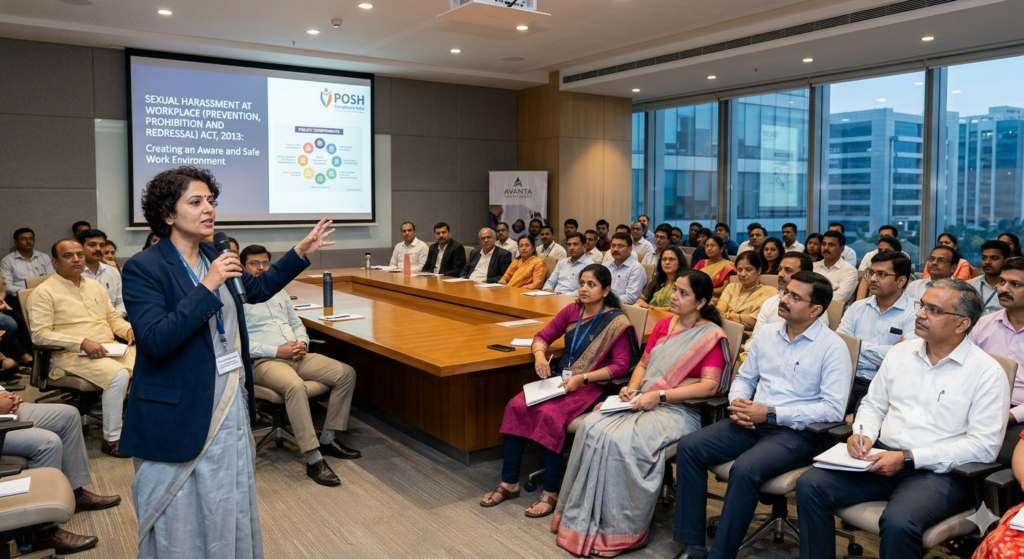
Sexual Harassment at the Office
What Every Employee and Employer Needs to Know
Sexual harassment in the workplace is not just a legal issue. It’s not just a legal problem, but a cultural one at the workplace, a leadership issue, a human one. Workplace sexual harassment influences employees’ confidence, their mental health, productivity and their trust in the organisation.
In India, even though it has introduced stronger, more rigid laws and has much greater recognition, employees are mostly afraid of reporting incidents for fear of the other side being stigmatised for reporting the issue, or of retaliation or having to seek help. Other times, too, POSH compliance can feel like an errand to be completed, but by no means the solution, as many companies will see it simply as a box to check at the end of the day instead of supporting a safe and respectful work environment.
At Maha POSH, we believe workplaces should feel safe for everyone, regardless of gender, role, or hierarchy.
India introduced the Sexual Harassment of Women at Workplace (Prevention, Prohibition and Redressal) Act, 2013 (aka the POSH Act), to safeguard women in the workplace from sexual harassment. The statute mandates that employers ensure a safe working environment and have in place avenues for the redress of grievances.
The POSH Act applies to:
- Private companies.
- Startups.
- NGOs.
- Government offices.
- Educational institutions.
- Hospitals.
- Freelance and contractual workplaces.
- Hybrid and remote workplaces.
Any organisation with 10 or more employees must establish an internal committee (IC) to consider complaints of sexual harassment in the workplace. A failure to observe this can lead to:
- Monetary penalties.
- Cancellation of business licenses.
- Reputational damage.
- Legal action.
What Counts as Sexual Harassment in the Workplace?
Most people believe that harassment simply refers to physical harassment. The truth is that workplace sexual harassment can happen in subtle, verbal, digital or psychological ways. Here are a few popular examples:
Physical Behaviour
- Unwanted touching.
- Hugging without consent.
- Blocking someone’s movement.
- Physical advances.
- Inappropriate proximity.
Verbal Behaviour
- Sexual jokes.
- Double-meaning comments.
- Comments on appearance.
- Repetitive requests for dates.
- Sexually suggestive discussions.
Non-Verbal Behaviour
- Staring.
- Leering.
- Inappropriate gestures.
- Sending explicit emojis or GIFs.
- Sharing inappropriate memes.
Online Harassment
In today’s digital workplace, online harassment is common. Examples include:
- Late-night inappropriate messages.
- Sexual comments on video calls.
- Sharing explicit material in office groups.
- Cyberstalking colleagues.
- Harassing employees on social media through social networks.
Even remote employees are shielded by the POSH Act.
Why Many Cases Go Unreported
A single biggest area of concern in sexual harassment at work is underreporting. Staff are reluctant to report because they fear:
- Losing their jobs.
- Workplace isolation.
- Career damage.
- Character assassination.
- Being blamed.
- Lack of evidence.
- Unsupportive management.
In many organisations, victims hear “ignore it,” “adjust”, or “avoid creating drama.” This silence also perpetuates toxic behaviour. It is this silence that allows toxic behaviour to go uncorrected. Prevention must recognise that trust begins with organisations starting from a place of trust. Workers will be assured that their complaints will be received in a manner that is open, confidential, and professional (i.e., they will be confident that they will not be treated unfairly).
Workplace Harassment & Emotional Impact
Sexual harassment in workplace does not just have an effect on work performance. It impacts emotional and mental well-being in profound ways. Victims may experience:
- Anxiety.
- Panic attacks.
- Depression.
- Sleep problems.
- Lack of confidence.
- Emotional exhaustion.
- Fear of going to work.
- Reduced concentration.
In extreme cases, employees quit jobs they loved for real because the work environment no longer feels safe. For employers, this leads to:
- Higher attrition.
- Lower morale.
- Reduced productivity.
- Brand reputation damage.
- Legal risk.
- Poor workplace culture.
A safe workplace is not simply ethical. It is a must to grow as a business.
Internal Committee (IC): Legal Requirement
All organisations with 10 or more staff members need to establish an Internal Committee under the POSH Act. The IC is responsible for:
- Receiving complaints.
- Conducting inquiries.
- Ensuring confidentiality.
- Providing fair hearings.
- Recommending action.
- Submission of annual reports.
The committee must include:
- A senior woman employee who is a Presiding Officer.
- At least two employees who have a passion for women’s welfare or legal awareness.
- One person from the outside who knows POSH laws or women’s rights.
At [Maha POSH](https://mahaposh.ai?utm_source=chatgpt.com), we empower organisations to develop legally sound internal committees, as well as staff members, who are trained to resolve matters professionally and sensitively, with the sensitivity of attorneys.
Reporting Sexual Harassment in the Workplace
Timely actions are needed if an employee faces sexual harassment at workplace.
Step 1: Record everything down.
Keep comprehensive files, including:
- Dates.
- Time.
- Location.
- Nature of incidents.
- Witnesses.
- Emails.
- Screenshots.
- Chat messages.
Documentation enhances the complaint process.
Step 2: Create a written complaint.
The complaint should ideally be filed within 3 months of the incident to the Internal Committee. In some cases the timeline could be extended.
Step 3: Attend the Inquiry.
The IC will conduct the investigation confidentially and fairly. Before there is any judgement, both parties get an audible conclusion.
Step 4: Follow the Outcome
Based on the results, the organisation may recommend you:
- Apologise in writing.
- Warning.
- Salary deduction.
- Transfer.
- Suspension.
- Termination.
- Counselling.
- Legal escalation.
What if There Is No Internal Committee?
In practice, many organisations are still failing to establish an Internal Committee which is required by law. In such cases, employees may:
- Approach the Local Committee set up by local authorities.
- Take complaints through the SHe-Box portal.
- Get legal help.
The SHe-Box portal, a single point of contact for women victimised by sexual harassment at the workplace, was launched by the Government of India.
Employer Responsibilities Under the POSH Act
Employers are the primary safeguard against workplace harassment. POSH compliance is not just about policy generation. Bodies need to be proactive in developing and implementing awareness and accountability. These are key duties faced by employers:
Create a POSH Policy
Anti-sexual harassment policies should be clear in every company, that are comprehensive and provide clarification to:
- Definitions.
- Reporting process.
- Inquiry procedures.
- Employee rights.
- Disciplinary actions.
Regular Training is A Good Start
Employees, managers, and leadership teams all need awareness sessions. Training should cover:
- Identifying harassment.
- Respectful behaviour.
- Bystander intervention.
- Reporting procedures.
- Digital workplace conduct.
Confidentiality is key to investigations. There is no one-way flow of information from complaints to witnesses to proceedings and they must always be kept private.
Foster a Safe Workplace Culture
Leaders should promote respectful communication and zero tolerance for transgressions. Culture begins from the top, no matter what.
The workplace as a practice changed drastically in the modern period. Workers now work across:
- Home offices.
- Co-working spaces.
- Client locations.
- Virtual teams.
- Platforms of video conferencing.
This has broadened the definition of workplace boundaries. Now, sexual harassment in the workplace can take place via:
Zoom calls.
- Slack messages.
- WhatsApp groups.
- Social media interactions.
- Work-related travel.
Many companies continue to lack clear digital conduct policies.
By Maha POSH, we encourage organisations to improve POSH policies to include remote and hybrid workplace behaviour standards.
Myths About Sexual Harassment in the Workplace
“It was just a joke.”
Intent does not always matter as much as impact.
“Only women face harassment.”
The POSH Act is, on paper, protective of women. But organisations need to put in place policies and programmes that will support the safety and dignity of all staff; the POSH Act’s specific provisions for women are the most important.
“Accusation of senior employees cannot be made.”
Harassment can occur at any level of status or hierarchy.
“If somebody didn’t complain immediately, it wasn’t a matter of concern.”
Abuse, fear, and workplace workload pressure often prevent workers from moving forward, delaying reports.
How Organisations Can Build Safer Workplaces
The prevention of sexual harassment in a work setting demands long-term commitment. Here is what organisations should do:
Establish Trust-Based Reporting Systems
Staff members should be able to report concerns without fear of retaliation.
Train Managers Properly
In workplace disputes, managers are frequently the first point of interaction. They shouldn’t just take the job-related advice; rather, they need to know how to respond in an appropriate and compassionate manner.
Advocate for Respectful Language
Small cultural shifts are important. Respectful communication needs to be brought into the workplace culture as a standard of behaviour.
Companies must revisit periodically the following:
- POSH policies.
- Complaint handling.
- Training effectiveness.
- Awareness levels.
Collaborate with POSH Experts
Compliance is ensured through external specialists who provide unbiased advice and rigorous enforcement.
No Formality in POSH Compliance
Why should POSH Compliance never be treated as a mere formality? A lot of firms do one yearly session to “just finish compliance.” Employees immediately note when awareness initiatives are more tokenistic. For a POSH to work, real implementation needs:
- Leadership involvement.
- Consistent communication.
- Strong accountability.
- Safe reporting systems.
- Continuous education.
Organisations work better for employees who feel psychologically safe. Safe workplaces enable the attraction of better talent, the retention of employees longer, and the fostering of healthier professional relationships.
How MahaPOSH Serves Organisations
We partner with organisations to build safer, more compliant workplaces and more respectful workplaces. Our services include everything from POSH policy development to internal committee installation, external member services, employee awareness sessions, POSH training for managers, annual report preparation, compliance audits, and consultation on hybrid workplace POSH. Combining legal insights with pragmatic workplace expertise, we bring POSH compliance to a whole new level, making it easier to navigate, more orderly, and easier to achieve.
Sexual harassment in the workplace is not an insignificant HR concern organisations can afford to dismiss. It undermines the dignity of employees, workplace trust and corporate culture. Every employee deserves to work in a workplace where they feel respected, listened to, and safe. And every employer has the opportunity to build that culture. Prevention happens through awareness, accountability, and work. It is not about compliance, but also about progress. The goal is to create workplaces where people can thrive without fear.
MahaPOSH also has the capability to meet your organisation where they are, whether POSH compliance is needed, POSH awareness programs need to be carried out, or a POSH internal committee to ensure compliance.